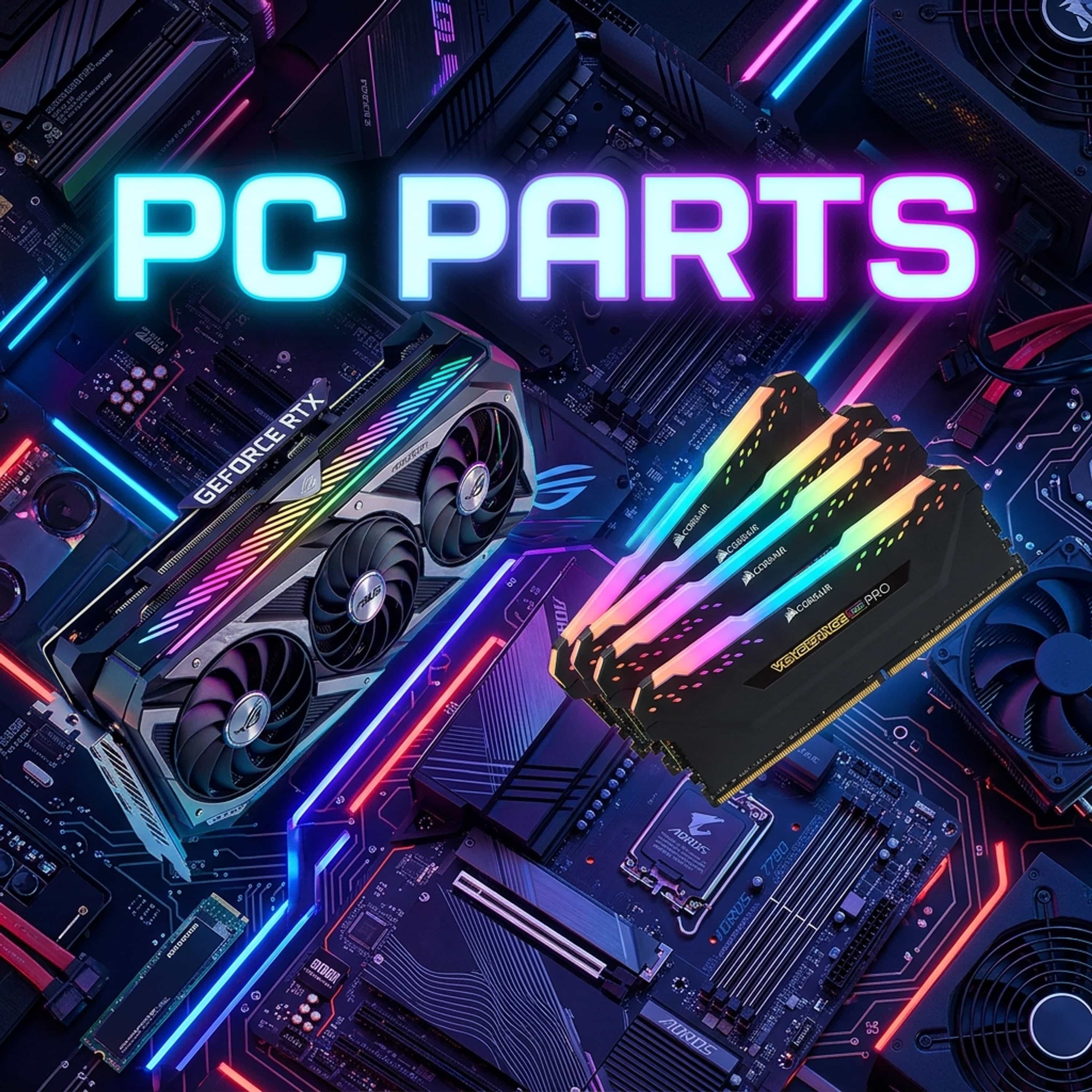
Nvidia RTX 5090: Price Shock, Power Draw, and DLSS 4
We break down the RTX 5090’s jaw-dropping price, enormous size, and monster specs, from 32GB of GDDR7 and 21,760 CUDA cores to the 600W power demand. The episode also dives into real-world gaming gains, DLSS 4 Multiframe Generation, and the trade-offs of heat, latency, and coil whine.
Is this your podcast and want to remove this banner? Click here.
Chapter 1
The Monster is Here: Nvidia RTX 5090 Specs & First Impressions
Skye Newman
Welcome to the show everyone! I'm Skye Newman, here with Eric Marquette. And Eric, I need to start with a number that genuinely made me think my internet browser had a virus when I saw it: two thousand, three hundred pounds. For a single computer part.
Eric Marquette
Two thousand three hundred is actually the conservative baseline for the Nvidia RTX 5090 Founders Edition, Skye. If you look at partner cards like the Asus ROG Strix, we are seeing retail listings pushing past two thousand eight hundred pounds. But what you are paying for is the absolute pinnacle of Nvidia's Blackwell architecture.
Skye Newman
Two grand eight? Are they fucking mental? That is more than my first three cars combined! What on earth are they packing inside this thing to justify that kind of daylight robbery?
Eric Marquette
Well, the silicon itself is staggering. We are talking about twenty-one thousand, seven hundred and sixty CUDA cores. To put that in perspective, the previous flagship, the 4090, had sixteen thousand three hundred and eighty-four. And then there is the memory subsystem: thirty-two gigabytes of ultra-fast GDDR7 VRAM running on a massive five-hundred-and-twelve-bit bus.
Skye Newman
Thirty-two gigabytes of GDDR7? My music production rig only has thirty-two gigs of system RAM total! Why does a graphics card need that much memory just to run some video games?
Eric Marquette
It is not just for standard games, though it does allow for uncompressed ultra-texture packs at high resolutions. The real bandwidth here is one point seven terabytes per second. That massive pipe is designed for heavy-duty local AI model training, massive rendering workloads, and path-traced gaming at native resolutions without breaking a sweat.
Skye Newman
Right, but have you seen the physical size of this bloody thing? I saw a picture of a guy holding it, and it looked like he was cradling a newborn baby. Or a literal brick of solid gold. It is four slots thick, Eric! It weighs over three kilograms!
Eric Marquette
Three point four kilograms, to be precise, for some of the triple-fan custom models. The cooling array is basically a giant vapor chamber slapped onto a dense aluminum fin stack. It is so heavy that almost every manufacturer is including a metal support kickstand in the box because otherwise, it would literally rip the PCIe slot clean off your motherboard.
Skye Newman
A kickstand! For a graphics card! That is proper comedy. Imagine building a sleek, beautiful PC, and you have to prop up your graphics card with a tiny car jack so it doesn't snap your expensive motherboard in half. It is absolute madness.
Chapter 2
Performance Realities & DLSS 4
Eric Marquette
The physical absurdity is hard to ignore, but the performance data is where the engineering really shines. In pure rasterized 4K gaming, we are seeing a solid twenty to thirty percent performance uplift over the 4090. But when you turn on full path tracing in titles like Cyberpunk 2077 or Alan Wake 2, that gap widens to nearly fifty percent.
Skye Newman
Fifty percent is a massive jump, I give you that. But let's be real, how many frames are we actually getting? Because if a 4090 was already giving you a hundred frames, is anyone really going to notice the difference between that and a hundred and fifty?
Eric Marquette
If you are running a high-refresh-rate 4K OLED monitor at two hundred and forty hertz, you absolutely will. But the real headline feature for Blackwell is DLSS 4, which introduces Multiframe Generation. Instead of generating every other frame like DLSS 3 did, DLSS 4 actually uses a new optical flow accelerator to generate multiple intermediate frames using neural rendering.
Skye Newman
Hold on, neural rendering? That sounds like marketing speak for "we are making up frames out of thin air." If my graphics card is just guessing what the next frame should look like, does it actually feel responsive when you are playing, or does it feel like sluggish shit?
Eric Marquette
That is the key engineering challenge. When you generate three synthetic frames for every one traditionally rendered frame, you introduce latency because the game loop has to wait for those frames to generate. Nvidia is combating this by making Reflex mandatory with DLSS 4 to pull that latency back down to around thirty milliseconds, but it is still a simulated experience.
Skye Newman
Exactly! Thirty milliseconds might sound fast to a tech head, but if you are playing a fast-paced shooter, you can feel that slight delay. It is like trying to run through wet cement. I don't want fake, artificial frames, I want raw, pure speed that reacts the second I click my mouse.
Eric Marquette
The raw speed is there, but path tracing is simply too heavy for native silicon right now. Even with twenty-one thousand cores, running full path tracing at native 4K would drop the 5090 to around forty frames per second. So like it or not, these AI shortcuts are the only way we are going to experience true photorealism in real-time.
Chapter 3
The Dark Side: Coil Whine, Power, and Heat
Skye Newman
Fine, but all that AI wizardry comes at a massive cost to your electric bill, doesn't it? I heard this absolute monster draws more power than a small village.
Eric Marquette
The rated TDP is six hundred watts. Under peak transient loads, it can spike even higher, which is why most system builders are recommending at least a thirteen-hundred-and-fifty-watt power supply. And you have to use the revised twelve-V-two-by-six power connector, which replaces the notoriously melt-prone twelve-V-H-P-W-R cable from the last generation.
Skye Newman
Six hundred watts! My microwave uses less power than that when I'm heating up a bowl of soup! And don't get me started on the heat. If you put that inside a small room in the summer, you're basically sitting next to a space heater. You'll be sweating your tits off just playing some Minecraft.
Eric Marquette
It definitely expels a massive amount of hot air. If you are putting this in a small form factor case, like the Lian Li Dan A3, you have to be incredibly strategic with your airflow. You need high-static-pressure exhaust fans spinning at two thousand RPM just to keep the internal case ambient temperature below fifty degrees Celsius, otherwise, your NVMe SSDs will literally thermal throttle.
Skye Newman
That sounds like a proper headache. And then there is the noise. I've been reading forums where people are complaining about this horrible, screechy coil whine. What is that about?
Eric Marquette
Coil whine is caused by the physical vibration of the inductors on the graphics card's power delivery system as current passes through them. With a six-hundred-watt draw, those inductors are under immense electrical stress. When you are running games at high frame rates, it creates a high-pitched metallic squeal that can bypass even closed-back headphones.
Skye Newman
Oh, hell no. If I am spending nearly three thousand pounds on a graphics card, and it starts screaming at me like a dial-up modem from nineteen-ninety-nine, I am throwing it straight out the window. That would drive me absolutely mental!
Chapter 4
The 2026 Upgrade Verdict: Who is this actually for?
Eric Marquette
It is definitely a hard pill to swallow, especially when you consider the system bottlenecks. If you are buying a 5090, you cannot pair it with just any processor. You need something like the new Ryzen 9 9800X3D, which is currently retailing for around four hundred and fifty pounds, just to keep up with the frame throughput.
Skye Newman
But wait, what if someone is already running the older Ryzen 7 7800X3D? Do they really need to shell out another four-fifty for the new chip, or is that just Nvidia and AMD colluding to empty our bank accounts?
Eric Marquette
At 4K resolution, the 7800X3D is actually still perfectly viable because you are almost always GPU-bound at that pixel count. But if you drop down to fourteen-forty-p, the 7800X3D will bottleneck the 5090 by about fifteen percent compared to the 9800X3D. But then again, if you are buying a 5090 to play at fourteen-forty-p, you are doing it wrong anyway.
Skye Newman
Exactly. It is pure flexing at that point, innit? It is like buying a Ferrari just to drive it to the local corner shop for a pint of milk.
Eric Marquette
It really is. The 5090 is not a sensible purchase for ninety-nine percent of gamers. It is a halo product. It is for extreme enthusiasts who demand the absolute best, or professionals who need thirty-two gigabytes of VRAM for local machine learning models but cannot afford a twenty-thousand-dollar enterprise Quadro card.
Skye Newman
Well, those rich tech bros can keep their screaming, massive, electric-guzzling bricks. I'll stick to my mid-range card and keep my heating bills down, thank you very much!
Eric Marquette
Probably a very wise financial decision, Skye. That is all we have for today's deep dive into the absolute monster that is the RTX 5090.
Skye Newman
Yeah, thanks for listening everyone! Try not to spend your rent money on a graphics card, and we will catch you next time! Bye!